
AI Workforce Planning: The Complete Guide to Building an AI-Ready Organisation

AI doesn't replace your workforce. It amplifies the one you already have.
Introduction
Most conversations about artificial intelligence in business start in the wrong place. They start with the technology: which model to use, which tool to buy, which department gets first access. The question that actually determines whether AI adoption succeeds rarely gets asked early enough: are our people ready for this, and are we ready to support them through it?
This is the question behind AI workforce planning, and it is quickly becoming one of the defining challenges for business leaders across the UK. Not because AI is a threat to be managed, but because AI is a capability that has to be built into an organisation deliberately, through people, skills, culture and leadership, rather than bolted on through software licences alone.
If you are a CIO, CTO, Head of Technology, HR Director or CEO asking "how do we prepare our workforce for AI," you are asking a better question than most of the market. This guide exists to answer it properly, without hype, without fear, and without pretending that a single tool or a single hire solves the problem.
This is the cornerstone guide for our AI Workforce Planning hub. Every section below introduces a topic in enough depth to be genuinely useful on its own, and points towards more detailed articles we will publish on each theme over time, from AI literacy and AI governance to sector-specific playbooks for cyber security, cloud, networking and software development.
What is AI Workforce Planning?
AI workforce planning is the structured process of preparing an organisation's people, skills, culture, leadership and governance so that AI can be adopted successfully and sustainably.
It sits at the intersection of three disciplines that are usually kept separate: technology strategy, workforce planning, and change management. Traditional workforce planning asks how many people you need, with what skills, in what roles, over what timeframe. AI workforce planning asks the same questions, but adds a new layer: which tasks and workflows will be reshaped by AI, which skills become more valuable as a result, which roles need to evolve, and how do you get your existing people from where they are now to where they need to be.
Crucially, AI workforce planning is not the same as AI recruitment. Recruitment is one possible outcome of workforce planning, used selectively when a genuine capability gap cannot be closed through training or internal mobility. But for most organisations, most of the work of becoming AI-ready happens with the people already on the payroll. It is a workforce strategy first and a hiring strategy second.
A useful way to think about it: if your organisation adopted a powerful new AI tool tomorrow, would your teams know how to use it well, would your managers know how to lead through the change, would your data and governance be sound enough to trust the output, and would your culture support experimentation rather than quiet resistance? AI workforce planning is the discipline of being able to answer yes to all four.
Why AI Should Enhance People Rather Than Replace Them
There is a persistent narrative that AI is coming for jobs, and it makes for compelling headlines but poor strategy. The more accurate and more useful framing, supported by the bulk of credible research, is that AI changes the tasks within jobs far more than it eliminates jobs outright.
UK government analysis published in 2026 estimated that around 70% of UK workers are in occupations containing tasks that AI could potentially perform or enhance. That sounds dramatic until you understand what it actually means: a task being exposed to AI is not the same as a role disappearing. It means parts of a job, often the repetitive, administrative or data-heavy parts, can be automated or accelerated, freeing people to focus on judgement, relationships, creativity and problem solving.
This distinction matters enormously for how leaders talk about AI internally. When AI is framed as a threat, employees hide their use of it, resist training, and disengage from transformation efforts. When AI is framed honestly, as a tool that removes friction and repetitive work so people can do higher value work, adoption accelerates and anxiety drops.
There is also a practical business reason to lead with augmentation rather than replacement. The organisations getting the most value from AI are not the ones cutting headcount fastest. Research from McKinsey has found that the great majority of businesses using AI report little to no change in workforce size in the past year, with the primary driver of adoption being efficiency and productivity gains rather than headcount reduction. UK data tells a similar story: only a small single-digit percentage of AI-using UK businesses report that AI has reduced their overall headcount so far, while the majority who deploy AI report improved productivity.
The organisations pulling ahead are the ones using AI to help existing employees do more, not the ones assuming technology alone can replace institutional knowledge, client relationships, technical judgement and leadership.
This is the philosophy that underpins everything else in this guide. AI workforce planning is not about managing decline. It is about preparing people to do their best work with better tools. We will explore this theme in more depth in a dedicated article, Why AI Should Enhance Employees, Not Replace Them, but it is worth stating plainly here: any AI strategy built on the assumption that people are the problem to be automated away is a strategy built on a false premise, and it tends to fail.
Why AI Workforce Planning Matters Now
AI adoption in the UK has moved from experimentation to early mainstream in a short space of time. Official data from the Office for National Statistics shows that AI adoption among UK businesses roughly tripled between late 2023 and early 2026, though it remains far from universal, and adoption is heavily skewed towards larger organisations. Businesses with 250 or more employees are now adopting AI at close to double the rate of the average UK business, while small and micro businesses lag considerably behind.
At the same time, demand for AI-related skills has grown far faster than the talent supply. Global research from McKinsey found that the number of workers in occupations explicitly requiring AI fluency grew roughly sevenfold in the space of two years. Gartner has separately estimated that a large majority of the engineering workforce will need meaningful upskilling within the next few years simply to keep pace with how AI is changing their day-to-day work.
This creates a specific and uncomfortable gap for many organisations: the technology is often more ready than the workforce. Leaders can buy access to powerful AI tools in an afternoon. Building the skills, governance, culture and leadership capability to use those tools well takes considerably longer, and it does not happen by accident.
There is also a scaling problem worth naming honestly. Multiple studies, including McKinsey's own research, have found that while the vast majority of organisations are using AI in at least one business function, only a small fraction have reached what researchers describe as genuine AI maturity, where AI is embedded systematically across workflows rather than used in isolated pilots. The most commonly cited reason organisations get stuck in what some analysts call "pilot purgatory" is not the technology itself. It is skills gaps, unclear ownership, weak governance and workflow rigidity, all of which are workforce and organisational issues rather than technical ones.
In other words, the businesses that plan their workforce transition deliberately are the ones most likely to convert AI investment into real productivity gains. The businesses that treat AI purely as a procurement decision are the ones most likely to end up with expensive tools that nobody quite knows how to use well.
For UK business leaders specifically, this is not a future problem. It is a present one, and the gap between AI-ready organisations and the rest is widening every quarter.
Introducing the Dynamic AI Workforce Framework
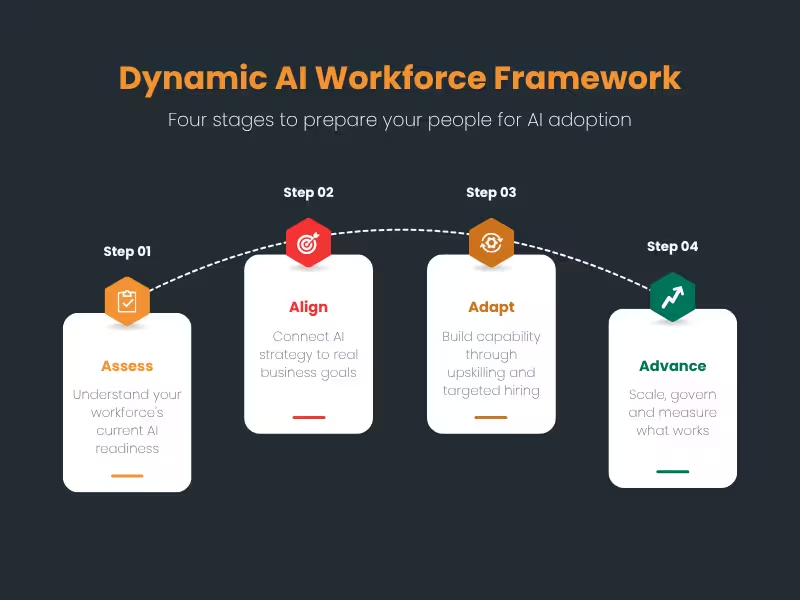
To make AI workforce planning practical rather than abstract, we use a simple four-stage framework across all of our AI workforce content. We call it the Dynamic AI Workforce Framework, and it is built around the four things every organisation needs to get right, in roughly the order they need to happen.
Assess. Understand where your organisation genuinely stands today: current skills, current culture, current governance maturity, and where AI could realistically create value in your specific business. This stage is about honest diagnosis before action.
Align. Connect AI strategy to real business objectives and get leadership genuinely aligned, not just informed. This stage is about making sure AI adoption is driven by business goals rather than technology for its own sake, and that leaders across the organisation are equipped to sponsor and model the change.
Adapt. Build the capability to use AI well, through a deliberate combination of upskilling, reskilling, internal mobility and, where genuinely necessary, targeted hiring. This stage is where most of the practical workforce transformation happens.
Advance. Scale what works, govern it responsibly, and measure the impact in terms that matter to the business. This stage turns successful pilots into embedded, sustainable capability, with the governance and measurement needed to keep improving over time.
We will reference this framework, Assess, Align, Adapt, Advance, throughout our AI workforce content, and each stage has its own deeper resources on our hub. The rest of this guide walks through each stage in more detail.
Assessing Your Current Workforce
Before any training programme, hiring plan or AI governance policy makes sense, an organisation needs an honest picture of where it currently stands. This is the Assess stage of the framework, and it is the stage most often skipped, usually because leaders are eager to show progress and jump straight to tools and training.
A proper workforce assessment for AI readiness looks at several distinct dimensions, not just technical skill:
Current AI usage, including shadow use. In most organisations, employees are already experimenting with AI tools, often without formal sanction or training. Surveys consistently show a large majority of knowledge workers using generative AI tools of some kind, frequently ahead of any official company deployment. This is not a compliance failure to be punished. It is useful signal. Understanding what your people are already doing with AI, and why, tells you where genuine demand and genuine risk both sit.
Digital and data literacy across teams. AI tools are only as useful as the judgement applied to their outputs. Teams with strong existing data literacy tend to adapt to AI far faster than teams without it, because they already understand concepts like data quality, bias and verification.
Process and workflow maturity. AI adoption tends to expose weaknesses that already existed. If a process is poorly documented or inconsistently followed, adding AI to it usually produces inconsistent results rather than magically fixing it. Assessing your workforce for AI readiness inevitably means assessing your processes too.
Manager and leadership readiness. Employees take their cues from their direct managers more than from company-wide communications. A workforce assessment should honestly evaluate whether your management layer has the confidence and understanding to lead their teams through AI adoption, or whether they need support first.
Cultural appetite for change. Some teams are naturally curious and experimental. Others are more risk-averse, often for good professional reasons, particularly in regulated or safety-critical functions. Neither is wrong, but the assessment should identify where you are starting from so the pace of change can be calibrated sensibly.
We go into practical assessment methods, including how to run structured skills audits and readiness surveys without creating unnecessary anxiety, in our dedicated article on Building an AI-Ready Workforce. The key principle at this stage is simple: assessment should be honest rather than reassuring. An inflated view of your organisation's AI readiness is far more dangerous than an accurate but uncomfortable one.
Identifying Skills Gaps
Once you understand where your organisation stands, the next step is identifying the specific gap between the skills you have and the skills your AI strategy will require. This sounds straightforward but is where many organisations go wrong, usually by focusing exclusively on technical AI skills while ignoring the broader capabilities that actually determine success.
The AI skills gap is genuinely significant. Global research suggests that while the large majority of organisations report some form of AI training being available, a substantial proportion still report an ongoing AI skills gap, and only a minority describe their training as mature or organisation-wide. The most commonly cited barrier to integrating AI into existing workflows, according to multiple industry studies, is insufficient worker skills rather than technology limitations or budget. UK-specific research from the Federation of Small Businesses has found that a significant share of small firms cite a lack of knowledge as their main barrier to AI adoption, well ahead of cost concerns.
A useful way to think about the AI skills gap is in three layers.
Foundational AI literacy. This is understanding what AI tools can and cannot reliably do, how to interact with them effectively, and critically, how to evaluate their output rather than accepting it uncritically. This layer applies to almost everyone in the organisation, not just technical staff.
Applied and functional AI skills. This is knowing how to embed AI into a specific job function, whether that is using AI to accelerate code review, support financial analysis, improve customer service response times, or strengthen threat detection in a security operations centre. These skills are role-specific and usually best built through targeted, practical training rather than generic courses.
Specialist AI and data skills. This is the smaller pool of deep technical capability: building and fine-tuning models, managing AI infrastructure, engineering data pipelines, and designing AI systems responsibly. This is where genuine specialist hiring, rather than internal upskilling, tends to be necessary.
Most organisations significantly underinvest in the first layer and overinvest their attention in the third. Foundational AI literacy is cheap and fast to build relative to its impact, yet it is often treated as an afterthought compared with headline-grabbing specialist hiring. We explore this gap in detail, including how to structure a tiered training programme across these three layers, in our dedicated article on the AI Skills Gap.
The Skills Every AI-Ready Organisation Needs
Beyond the technical layer, there is a set of skills that consistently distinguishes organisations that adopt AI successfully from those that stall. Several global studies, including World Economic Forum research on future skills, point to a similar pattern: while AI and data skills are the fastest-growing category of in-demand skills, distinctly human capabilities such as critical thinking, creative problem solving, adaptability and resilience are rising in importance alongside them, not being displaced by them.
For a UK business preparing its workforce, the practical skill set worth building includes:
Critical evaluation of AI output. The single most important AI skill in any organisation is the ability to spot when an AI tool has produced something inaccurate, biased, incomplete or simply wrong. This is not a technical skill in the traditional sense. It is professional judgement applied to a new kind of tool, and it needs to be trained deliberately rather than assumed.
Effective AI interaction, sometimes called prompt literacy. Knowing how to communicate clearly with AI systems to get useful, relevant output is a learnable skill that dramatically affects how much value an employee gets from any given tool.
Workflow integration thinking. The ability to see where AI genuinely fits into an existing process, rather than using it as a novelty layered on top of unchanged work. This is often a bigger differentiator than raw technical skill.
Data fluency. Understanding what good data looks like, why it matters, and how poor data quality undermines AI output, is increasingly a baseline expectation rather than a specialist skill.
Ethical and governance awareness. Every employee using AI tools needs a working understanding of acceptable use, data privacy and the organisation's AI policy, not just the specialists responsible for writing that policy.
Human skills that AI cannot replicate. Relationship building, negotiation, complex judgement calls, creative direction and leadership remain firmly human skills, and organisations that invest in AI at the expense of these skills tend to see diminishing returns.
The organisations that get the most value from AI treat these as core professional skills to be developed across the workforce, not as niche technical training reserved for a small AI team. We cover how to structure this kind of broad-based skills programme, including sample curricula by role, in a future article on AI Upskilling.
Building an AI-Ready Culture
Skills and tools alone do not create AI readiness. Culture does the heavy lifting in determining whether those skills and tools actually get used well, and this is one of the most consistently underestimated parts of AI workforce planning.
UK government research into business AI adoption has found that cultural and behavioural factors, including poor early experiences that damage trust, overhyped expectations followed by disappointment, and uneven confidence across teams, are among the most significant barriers preventing firms from moving from experimentation to genuine integration. Technical staff are often comfortable experimenting on their own, while non-technical teams need clearer guidance, structured support and, importantly, permission to get things wrong while learning.
A genuinely AI-ready culture tends to share several characteristics.
Psychological safety around experimentation. Employees need to feel able to test AI tools, question their output, and admit when something did not work, without fear of embarrassment or blame. Organisations that punish early mistakes quietly train their people to hide AI use rather than use it well.
Transparent communication from leadership. Ambiguity breeds anxiety. When leaders communicate honestly about why AI is being adopted, what it is and is not intended to do, and how roles might evolve, employees engage far more constructively than when they are left to speculate.
Recognition that adoption will be uneven. Some teams will move faster than others, and that is normal rather than a sign of failure. A good AI-ready culture accommodates different paces of adoption rather than mandating uniform speed across a diverse organisation.
Genuine two-way feedback loops. The employees closest to the work are often the first to spot where AI tools help and where they create friction or risk. Cultures that listen to this feedback and adapt their approach outperform those that treat AI adoption as a one-way rollout from leadership.
Building this kind of culture is slower and less glamorous than deploying a new tool, but it is consistently the difference between organisations that convert AI pilots into lasting value and those that do not. We will return to this theme, including practical steps for building AI confidence at every level of an organisation, in our upcoming article on AI Change Management.
Hiring vs Upskilling
This is one of the most common questions we hear from technology and HR leaders, and it deserves a direct answer: for most organisations, most of the time, upskilling existing employees delivers more value, faster and at lower risk, than hiring new AI specialists.
This is not a recruitment agency saying hiring does not matter. It is an honest reflection of how AI capability actually gets built inside organisations. Upskilling has several structural advantages worth being clear about.
Existing employees already understand your business, your customers, your systems and your ways of working. Teaching them to use AI tools well is usually faster than teaching an external AI specialist your entire business context from scratch. Upskilling also tends to be significantly cheaper than hiring, particularly given how competitive and expensive specialist AI talent remains in the UK market. It preserves institutional knowledge and continuity rather than risking it walking out the door, and it sends a powerful cultural signal that AI adoption is about growth and capability, not replacement, which directly reinforces the augmentation-first message covered earlier in this guide.
That said, upskilling has real limits, and pretending otherwise leads to its own problems. Deep specialist capability, such as building and deploying custom machine learning models, engineering complex data pipelines, or leading enterprise-wide AI architecture, usually cannot be built quickly through internal training alone. Some skills take years of hands-on experience to develop properly, and trying to shortcut that with a training course sets expectations that will not be met.
The practical answer for most organisations is a blend: broad-based upskilling across the workforce to build foundational AI literacy and applied skills, combined with selective, targeted hiring for the small number of genuinely specialist roles that internal training cannot realistically fill within a useful timeframe. We explore how to make this decision role by role, with a simple decision framework, in our dedicated article on Hiring vs Upskilling.
When Should Businesses Hire AI Specialists?
Given the case for upskilling above, it is worth being specific about when hiring genuinely is the right answer, because there are clear situations where it is.
When you need deep technical capability that does not exist internally. Roles such as machine learning engineers, AI infrastructure specialists, and data scientists building custom models require years of specific technical grounding that cannot be compressed into an internal training programme. If your AI strategy depends on building proprietary models or complex AI infrastructure, this is a hiring problem, not a training one.
When speed matters more than cost. If a competitor is moving quickly on an AI-driven product or capability and you need equivalent expertise now rather than in twelve months, hiring an experienced specialist is usually faster than developing one internally.
When you need to establish new governance or leadership functions. Roles like AI ethics leads, AI governance specialists or heads of AI are increasingly being created specifically because organisations need dedicated ownership of responsible AI use, something that is difficult to bolt on as a part-time responsibility for an existing leader.
When internal capacity is already stretched. If your existing technical teams are already at full stretch delivering business-critical work, asking them to also become your organisation's AI specialists is often unrealistic, regardless of their potential to learn.
When hiring genuinely is the right route, the roles in highest demand across UK businesses currently include AI and machine learning engineers, data scientists and data engineers, AI governance and compliance specialists, and increasingly, hybrid roles that combine domain expertise with AI fluency, such as an AI-literate cyber security analyst or a marketing lead who understands how to responsibly deploy AI-driven personalisation.
If your organisation reaches this point and needs to bring in specialist AI capability, this is where a specialist technology recruitment partner adds genuine value, understanding not just where to find candidates but how to assess AI skills accurately in a market where the terminology moves quickly and titles are inconsistently applied. You can see how we approach AI recruitment specifically on our AI recruitment services page, and current UK salary benchmarking for AI and other technology roles is available in our 2026 IT Salary Guide.
Building Cross-Functional AI Teams
As AI adoption matures beyond individual tools and pilots, successful organisations tend to move towards a cross-functional model rather than isolating AI capability inside a single technical team.
This matters because AI value is rarely created by technology alone. It is created at the intersection of technical capability, domain expertise, and governance. A genuinely effective AI initiative usually draws on several perspectives at once: someone who understands the underlying technology, someone who deeply understands the business process being changed, someone who can assess risk and compliance implications, and someone with the change management skill to bring the wider team along.
A practical cross-functional AI team structure, scaled appropriately to organisation size, typically includes representation from technology and data, the specific business function being transformed, HR or people teams to manage the workforce and change implications, legal, risk or compliance for governance, and leadership sponsorship to remove obstacles and maintain momentum.
For smaller organisations, this does not need to mean new headcount. It can mean formally designating existing employees with partial responsibility across these areas and giving them the time and authority to do it properly. For larger organisations moving into serious AI scaling, dedicated cross-functional AI teams, sometimes centred around an AI centre of excellence, tend to significantly outperform siloed efforts.
The common failure mode worth naming: treating AI purely as an IT project. Organisations that leave AI decisions entirely to the technology function, without genuine involvement from the business functions being changed, consistently produce tools that are technically impressive but poorly adopted. We explore how to structure cross-functional AI teams in more depth, including practical governance models for smaller organisations, in our article on Building AI Teams.
The Role of Leadership
AI workforce planning ultimately rises or falls on leadership, and this deserves to be stated plainly rather than treated as a throwaway line. Every part of the framework covered so far, assessment, alignment, adaptation and scaling, depends on leaders who genuinely understand what they are asking their organisation to do and why.
Effective AI leadership does not require every CEO or CIO to become a technical AI expert. It requires something more specific: enough working understanding of AI's genuine capabilities and limitations to set realistic expectations, ask good questions of vendors and technical teams, and avoid both extremes of AI leadership failure, which are chasing every new tool without a coherent strategy, or dismissing AI as hype and falling behind competitors who do not.
Strong AI leadership tends to share a few consistent traits. Leaders communicate the "why" behind AI adoption honestly, connecting it to specific business outcomes rather than vague transformation language. They model the behaviour they want to see, using AI tools themselves rather than mandating adoption from a distance. They protect psychological safety by treating early mistakes as learning rather than failure. And critically, they are honest about uncertainty, acknowledging what they do not yet know rather than projecting false confidence, which builds far more trust with sceptical or anxious teams than performative certainty does.
There is a specific leadership gap worth flagging for UK organisations: McKinsey's research has found that employees frequently use AI tools more than their leaders realise, often without formal sanction. This is a signal that many leadership teams are underestimating both the appetite for AI adoption within their organisation and the governance risk it creates if left unmanaged. Closing this gap, through honest conversation rather than restrictive bans, is one of the fastest ways a leadership team can improve its organisation's AI readiness.
We look at this in more depth, including how to build AI fluency specifically at board and senior leadership level, in our dedicated article on AI Leadership.
AI Governance and Responsible AI
As AI usage grows inside an organisation, governance stops being optional. This is not primarily a legal compliance exercise, though compliance matters. It is a workforce and trust issue: employees, customers and partners need confidence that AI is being used responsibly, consistently and safely.
UK businesses currently operate in a sector-led AI governance environment rather than under a single overarching AI law. The government sets common regulatory principles, and existing regulators, such as the Information Commissioner's Office for data protection, apply them within their existing powers. This gives UK businesses meaningful flexibility, but it also means the responsibility for defining sensible internal AI policy sits largely with the organisation itself, rather than being handed down as a single fixed rulebook.
A practical AI governance approach for most organisations covers several core areas.
Acceptable use policy. Clear, accessible guidance on what AI tools employees can use, for what purposes, and what data can and cannot be shared with them. This needs to be written for a general audience, not buried in technical jargon that nobody reads.
Data protection and privacy. Ensuring AI tools are used in a way that respects data protection obligations, particularly where customer or employee data is involved.
Human oversight of AI output. UK government research found that the great majority of AI-using businesses apply meaningful human input or checking to AI-generated output, and this is genuinely good practice worth formalising rather than leaving to individual discretion. Decisions with real consequences, whether in recruitment, finance, customer service or security, should always retain a human decision-maker in the loop.
Bias and fairness monitoring. Particularly relevant in areas like recruitment, lending and performance evaluation, where AI tools can inadvertently reproduce or amplify existing bias if not carefully monitored.
Clear accountability. Someone in the organisation needs to own AI governance, even if it is a part-time responsibility in a smaller business. Diffuse or unclear ownership is one of the most common reasons AI governance quietly fails in practice.
Getting governance right is not about slowing AI adoption down. Done well, it is what allows adoption to accelerate safely, because employees, customers and leadership all have confidence in how AI is being used. We explore this in significantly more depth, including a practical governance checklist for UK businesses, in our dedicated article on AI Governance.
Measuring Success
A workforce transformed for AI adoption is only valuable if it is actually delivering results, and this is an area where many organisations struggle, largely because they measure the wrong things or fail to measure at all.
The most common measurement mistake is focusing exclusively on adoption metrics, such as how many employees have logged into an AI tool, without connecting that to genuine business outcomes. Usage is a leading indicator, not a result in itself.
A more useful measurement approach looks across several layers.
Productivity and efficiency metrics. Time saved on specific tasks, throughput improvements, and reduction in manual, repetitive work. These are usually the fastest metrics to move and the easiest to communicate to a wider business audience.
Quality and accuracy metrics. Whether AI-assisted work maintains or improves quality standards, tracked specifically rather than assumed. This matters enormously for maintaining trust in AI tools over time.
Skills and capability metrics. Tracking genuine growth in AI literacy and applied AI skills across the workforce, not just training completion rates, which are a weak proxy for actual capability.
Employee experience metrics. Whether AI adoption is genuinely reducing repetitive workload and improving job satisfaction, or quietly increasing stress and workload in ways that undermine the augmentation-first message covered earlier in this guide.
Business outcome metrics. Ultimately, AI investment needs to be connected back to metrics the wider business already cares about, whether that is revenue growth, customer satisfaction, cost reduction or risk reduction.
Research from Boston Consulting Group has found that organisations with mature, formal AI training programmes achieve meaningfully faster AI adoption and significantly higher AI return on investment than organisations struggling with talent gaps, with the majority of AI success attributed to people, process and change management rather than algorithms or infrastructure. This is a strong argument for treating workforce measurement as seriously as technical performance measurement. We cover how to build a practical AI measurement framework, including sample dashboards by function, in our upcoming article on Measuring AI ROI.
Common Mistakes Businesses Make
Having worked closely with technology leaders navigating this transition, a consistent set of mistakes tends to show up across organisations of very different sizes and sectors.
Leading with technology instead of business need. Choosing an AI tool first and then trying to find a use for it, rather than starting with a specific business problem and identifying whether AI genuinely helps solve it.
Treating AI as a one-off project rather than an ongoing capability. AI tools and best practices evolve quickly. Organisations that treat their first AI rollout as a finished project, rather than the start of an ongoing capability, quickly fall behind as the technology and their own maturity move forward.
Underinvesting in foundational skills while overinvesting in specialist hiring. As covered earlier, chasing a small number of expensive specialist hires while neglecting broad-based AI literacy across the wider workforce is one of the most common and costly imbalances we see.
Ignoring middle management. Company-wide AI announcements rarely translate into genuine adoption if middle managers are not equipped, informed and confident enough to lead their own teams through the change. This layer is consistently under-resourced in AI rollouts.
Weak or absent governance. Deploying AI tools quickly without clear policy on acceptable use, data handling or human oversight, then discovering gaps only after a problem has already occurred.
Framing AI as a threat, even unintentionally. Leaders who focus communication heavily on efficiency and cost savings, without equal emphasis on how AI benefits employees directly, inadvertently create the fear-based reaction that undermines adoption.
Failing to measure anything beyond adoption. As covered in the previous section, tracking how many people are using a tool without tracking whether it is actually improving outcomes.
Moving at a single, uniform pace across a diverse organisation. Assuming every team and function should adopt AI at the same speed, rather than allowing genuine differences in readiness, risk tolerance and use case maturity across different parts of the business.
Most of these mistakes are avoidable, and nearly all of them come back to the same root cause: treating AI adoption as a technology rollout rather than a workforce transformation.
The Future of AI Workforce Planning
Looking ahead, several trends are likely to shape how UK organisations approach AI workforce planning over the coming years.
AI literacy is likely to become a baseline professional expectation, similar to how basic computer literacy became non-negotiable through the 1990s and 2000s, but compressed into a much shorter timeframe. Organisations that treat AI literacy as core professional development, rather than optional or specialist training, will have a meaningful advantage in both productivity and talent retention.
New roles will continue to emerge that did not exist a few years ago, including AI governance specialists, AI ethics leads, and hybrid roles that combine deep domain expertise with strong AI fluency. UK government skills projections have suggested that jobs directly involving AI activities could grow substantially over the coming decade, spanning specialist, implementer and expert-level roles across a wide range of functions, not just technical ones.
Entry-level roles are likely to continue evolving rather than disappearing, but this deserves careful attention from leaders. Multiple UK studies have flagged a genuine risk that AI could reduce traditional entry-level opportunities and weaken the routes through which junior employees build foundational skills and experience. Organisations that plan deliberately for this, redesigning early-career roles around judgement, critical thinking and structured AI-assisted learning rather than simply reducing junior headcount, will be better positioned to build their future talent pipeline than those that do not.
The productivity gap between AI-mature and AI-immature organisations is likely to widen further before it narrows, as the organisations investing seriously in workforce readiness compound their advantage over those treating AI as a series of disconnected pilots.
And finally, workforce planning and technology strategy, historically separate functions in most organisations, are likely to continue converging. The organisations that succeed with AI over the next several years will be the ones where HR, technology and business leadership plan together rather than in isolation, which is precisely the thinking behind this guide and the framework it introduces.
Conclusion
AI workforce planning is not a side project sitting underneath your technology strategy. For most organisations, it is the strategy, because the value of any AI investment is ultimately determined by whether your people can and will use it well.
The organisations getting this right share a consistent pattern. They assess honestly rather than optimistically. They align AI strategy to genuine business goals rather than technology for its own sake. They invest deliberately in adapting their workforce, blending upskilling and targeted hiring rather than defaulting to one or the other. And they advance carefully, with governance and measurement built in from the start rather than added as an afterthought.
Most importantly, they treat AI as a tool that enhances the people already doing valuable work inside their organisation, not a replacement for them. That distinction, more than any specific tool or technology choice, is what separates AI adoption that genuinely transforms a business from AI adoption that quietly stalls.
This guide is the starting point for our AI Workforce Planning hub, and we will continue building out the detailed articles referenced throughout, covering everything from AI literacy and AI change management to how AI is reshaping specific technology disciplines like cyber security, cloud, networking and software development. You can find these as they are published on our blog, and practical tools and downloadable guides in our Resource Hub.
Ready to Build Your AI-Ready Workforce?
Whether you are at the very beginning of assessing your organisation's AI readiness, or you have reached the point where targeted specialist hiring genuinely makes sense, Dynamic Search can help. We work with technology and business leaders across AI, cyber security, cloud and DevOps, software development, networking, IT sales and audio visual to build the teams that make AI adoption succeed.
Explore our full range of recruitment services, learn more about how we support AI recruitment specifically, or browse live opportunities on our job board. For current UK technology salary benchmarks to support your own workforce planning, our 2026 IT Salary Guide is a useful place to start.